
Learning Thai · An honest answer
Is Thai hard to learn?
Thai is as hard as you think it is.
Go in thinking Thai is hard, and it will be. Go in seeing it as a fun challenge, and it becomes easy. Like learning anything, it depends on your approach, and on what you practise with.
- Verbs never change: no conjugations, no tense endings.
- No plural endings, and no gender for things.
- Short words, many of them one syllable.
- The word order is often like English.
- A vowel keeps its sound, unlike the a in cat, cake and car.
- Five tones: the pitch of a word changes its meaning.
- Long and short vowels: the same sound, held longer or shorter, can change the meaning.
- A new script, though you can start speaking without it.
- Speaking up when you are not sure you will get it right.
Thai compared with English
Different from English, but simpler
Thai feels hard because it works differently from English. Look closer and it is simpler.
Verbs
A verb never changes
In English, eat has five forms to learn: eat, eats, ate, eaten, eating. In Thai, กิน gin, to eat, stays the same. In short, Thai words never change their form like they do in English. Add a time word to say when.
Tones
Pitch you already use
In English, say “Yes!” as if you’re excited. Now say “yes” as if you’re scared, then as if you’re attracted, then as if you’d rather say no. You hear the pitch change, and anyone listening understands the feeling behind your yes. In Thai, the same changes in pitch change the word itself; Thais use other words to show the feeling. This can be challenging for English speakers because it’s a different use of tone, but the right explanations, tools and practice train your ears and voice to make your tones natural and easy. Same sound, different pitch, a different word:
Vowels
Long and short, like “no” and “nooo”
In English, the a in cat, cake and car changes its sound. In Thai a vowel keeps its sound; it is only short or long, like a quick “no” and a drawn-out “nooo”. In English that only adds feeling; in Thai the length changes the word:
It depends on your approach
The hard way and the easy way
Thai is not hard in itself. It feels hard when you learn it the hard way.
What makes Thai feel hard
Five things that make Thai feel hard, and how to make it easy
1 · Tones
“I can’t hear my own tones”
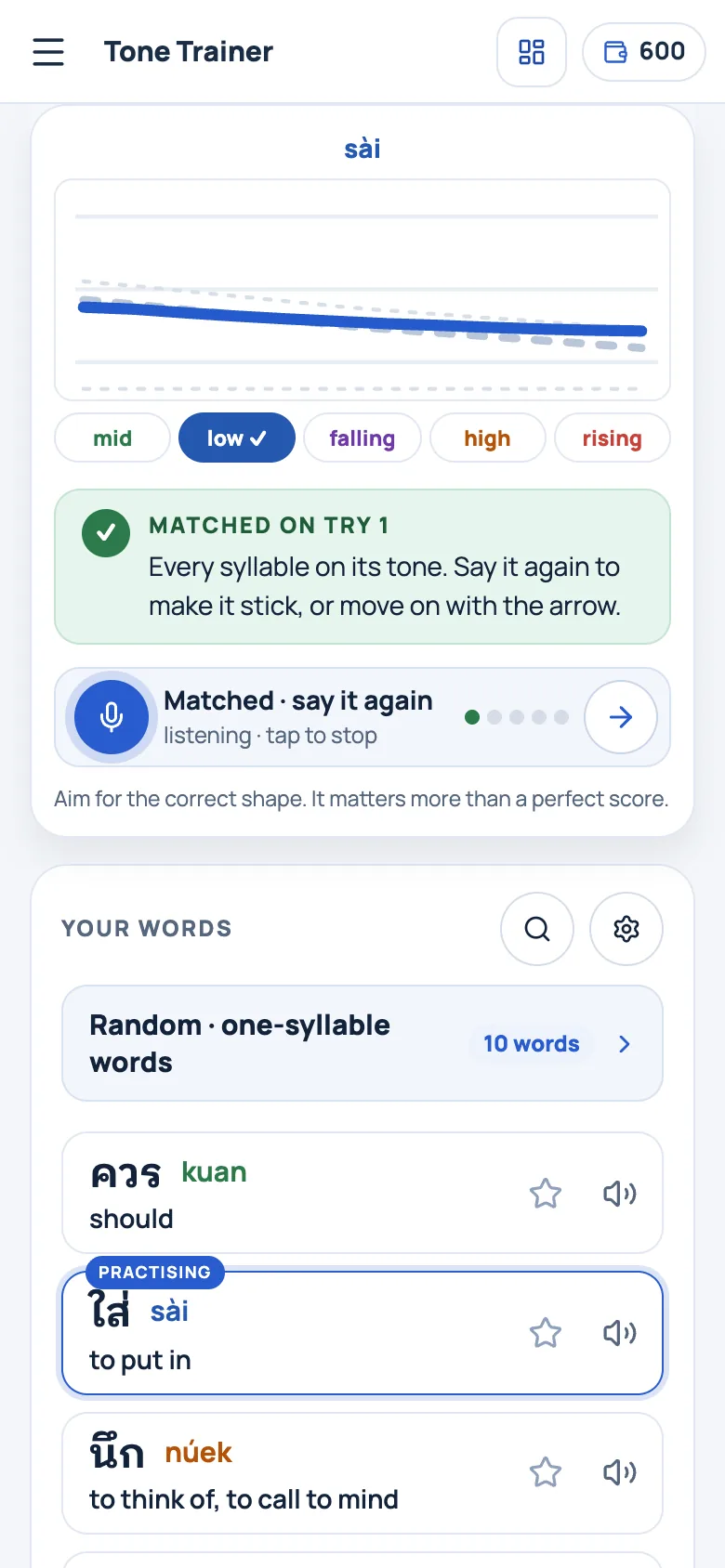
Many people think they are tone-deaf. But English speakers use tone all the time, to show feeling. Say yes five ways:
Same word, different pitch, a different feeling. So being tone-deaf is a myth: you just need to notice how you hear and make pitch, and use it on each word. That comes with practice, and the right tool to practise with.
2 · Karaoke
“The spelling doesn’t match the sound”
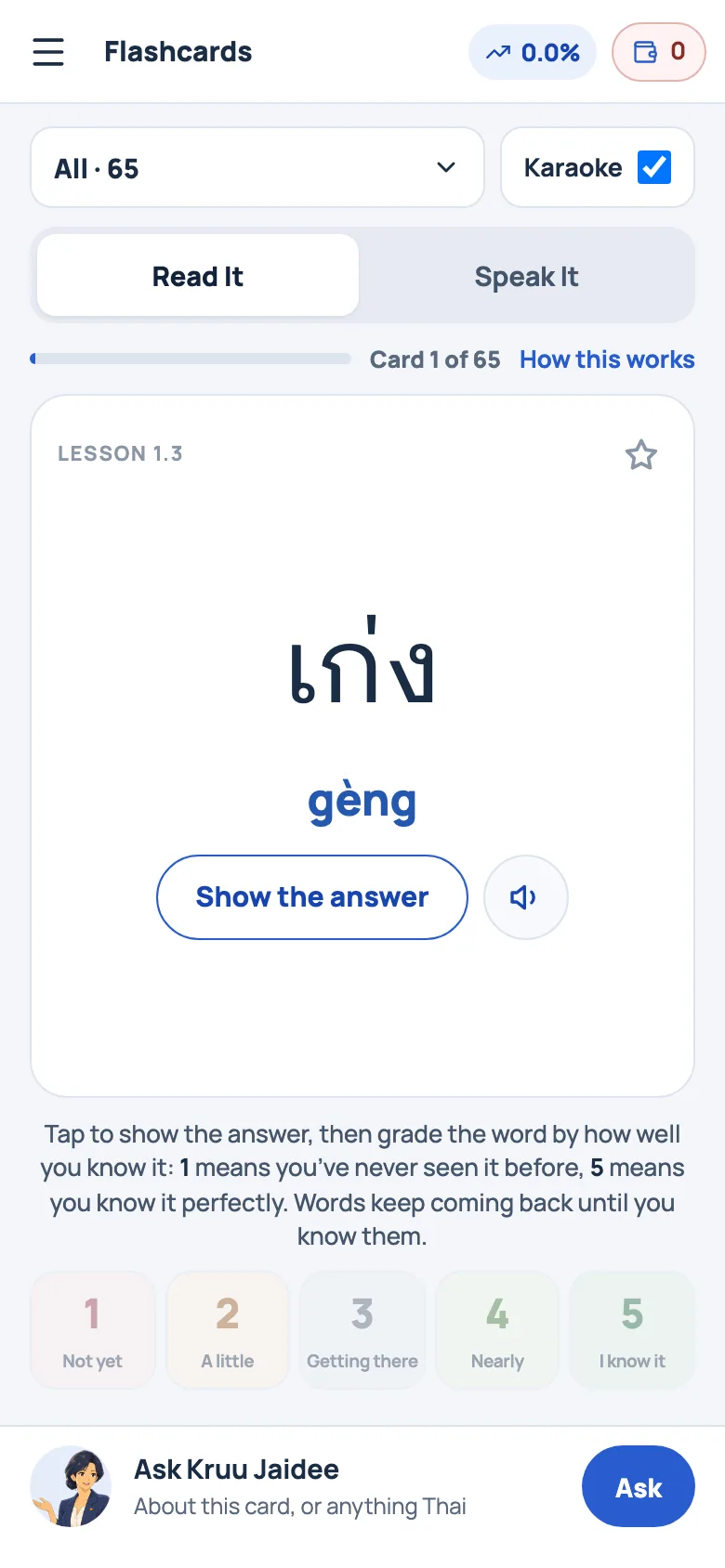
Every Thai course writes Thai words in English letters so you can read them. This is called karaoke. But English letters can never show a Thai sound exactly, so if you only read the karaoke, you will say the word like an English word. Use the karaoke as a guide or a reminder, and learn the real sound by listening to native speakers.
3 · Memory
“I forget words as fast as I learn them”
A word you meet once is gone by next week, and a long list of words you will never use is hard to care about. Repetition is the key to memory.

4 · The why
“Nobody can explain why”
Why is it ค่ะ kà here and คะ ká there? Why is it ผม pǒm for a man but ฉัน chǎn for a woman? Why do Thais end so many sentences with นะ ná? Why does a verb have no tense? Even native Thai teachers can find these hard to explain: they learned Thai as children, without the rules.
5 · Confidence
“I’m embarrassed to get it wrong”
With a teacher or a Thai friend, every mistake is in front of someone. So you stay quiet, and the fear slows you down more than the language does.

Questions
Is Thai hard? Common questions
Is Thai hard for English speakers?
Some parts are; others are easier than in English. The grammar is simple: verbs never change and nouns have no plural endings. The tones, the long and short vowels and the script take practice, and with the right approach and tools they get easier quickly.
What is the hardest part of Thai?
For most learners, the five tones: the pitch of a word changes its meaning. Seeing your own pitch, as the Tone Trainer shows it, makes them much easier to learn.
Do I need to learn the Thai script?
Not to start speaking. Karaoke, Thai written in English letters with marks for the tones, lets you speak from day one; the script can come later.
Is Thai harder than Chinese?
It is different. Thai has an alphabet rather than characters, and five tones to Mandarin’s four. Chinese speakers already hear tones, which gives them a head start.
Can I learn Thai on my own?
Yes, if you practise speaking. Kruu Jaidee gives you a course, a teacher to talk to and ask anything, and tools to check your tones, whenever you have a few minutes.
Find out how easy Thai can be
The first 5 lessons, the tone practice and the free tools are free, with no card and no email.